ideas / 1
The forward-deployed consultancy
Why enterprise AI requires a new kind of firm
Autonomous agents are no longer experimental. Teams are now using them for real, consequential work. Entire workflows are being automated, and work that once required hours or days now takes minutes. Agent-driven systems are only becoming more capable and more central to how companies function.
But agents can't architect, implement, or govern themselves.
Automations drift from their original intent, logic breaks, and ownership becomes unclear — while models and APIs continue to rapidly evolve. Without structured oversight, even well-designed systems degrade over time. It is no longer a question of what agents are capable of, but how well they are designed and managed.
Our thesis is simple: effective agent-driven systems require ongoing human stewardship. They require an embedded "human in the loop" who understands both the technology and the operational context in which it runs.
The old model
Traditional consulting wasn't built for this kind of work.
Most consulting firms work on an outdated assumption: that you can study a problem from a distance over months, and hand back a plan in the form of a slide deck. That worked when the technology largely held still, but it doesn't now. New models ship monthly; what defined the frontier last quarter is commodity today. By the time a traditional engagement delivers its strategy, that strategy describes a world that's already moved.
This is a structural failure.
Big firms run on a staffing pyramid: layers of account management, senior and junior tiers, a pitch team that wins the work and a delivery team that inherits it. Every layer is a handoff, every handoff a status call and a week of lag, and context is lost at each step until the people actually in your systems are the ones furthest from why the work is being done. Committees and approval gates are how firms that size manage risk, but they're also what put time and distance between the decision and the work.
And speed is only one half of it. The other half is judgment. The decisions that matter in agent deployment can't be made in a conference room. What to automate, where a human has to stay in the loop, what "reliable enough" means for a specific team and workflow — none of it survives the trip from slide to production. It has to be decided in the work, in real-time, by the person actually delivering it.
A better model for managing agentic systems
There's a better approach for this, and it inverts the traditional consulting practice. Instead of working at a distance, the people who make the decisions sit inside the work, close enough to move at the speed of the technology and make the right calls in context, the two things the old model can't do at once.
What I'm describing is essentially forward-deployed consulting: embedded alongside client teams, at the implementation layer, where the real problems surface. Methodology is built in live engagements, against real constraints: what reliable agent deployment actually requires inside an organization with real people, workflows, and technical debt.
We of course didn't invent this. Palantir famously built a company around this idea: forward-deployed engineers who sit inside the customer's problem instead of solving it from a distance and shipping the answer over the wall. Their insight was that for genuinely hard, context-dependent work, the distance between who builds the solution and where the problem lives is what kills it. We have found this to be particularly true when it comes to AI implementation.
Piloting this approach
We've spent the last year testing this on real enterprise engagements, and the pattern holds.
When we embed to deploy agents into a live operation, the initial build is rarely the hard part. What matters is what comes after — watching where the automations start to drift, where a human judgment call has to be written back into the logic, where governance is missing — which is the ongoing work of stewardship. In one engagement, we wired agents into the daily operation of an asset-heavy business — tracking performance across sites, surfacing what needed attention, reporting into the tools the team already used. What made it hold up wasn't just our architecture or foresight. It was proximity: being in the work when the gaps actually surfaced, and not just reading about them in a status update a week later.
And the expansion didn't come from a roadmap we pitched at the beginning. It came organically from being embedded enough to see what the organization actually needed once the first systems were live — never quite what a proposal would have predicted. That's the whole argument: the right next move is knowable only from the inside.
We firmly believe autonomous systems require human stewardship, and that an embedded, forward-deployed team is uniquely positioned to deliver that.
Cole Ryan
Principal & Founder, Montchanin Technology Company
“Their team was immensely helpful in bringing clarity and efficiency to our organization.”
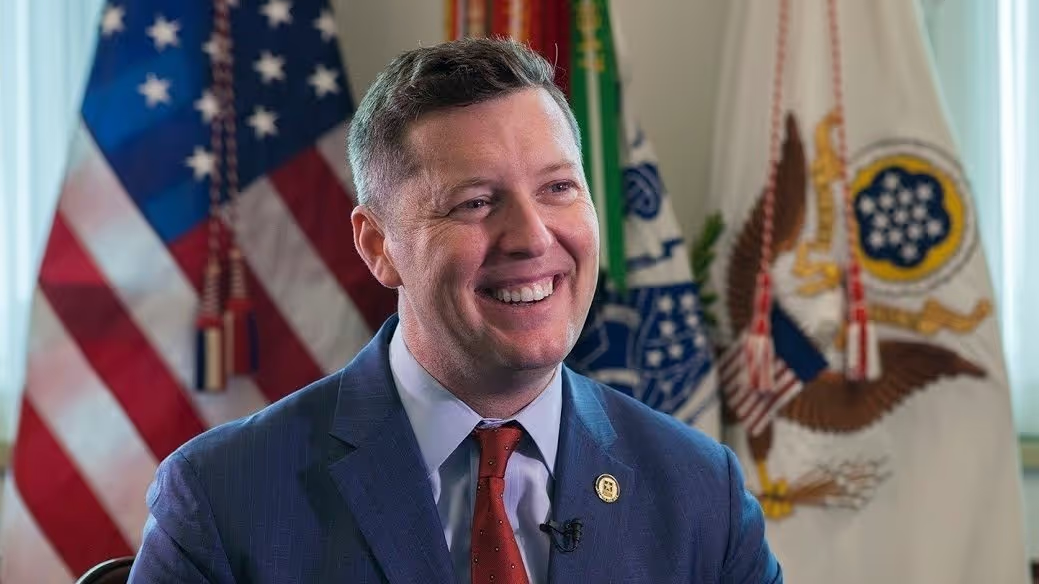
Patrick J. Murphy
Former Acting Secretary of the Army
& U.S. Congressman